world news and everything going on in the world
Показват се публикациите с етикет Mayan. Показване на всички публикации

сряда, 21 ноември 2012 г.

The Mayan Calendar

When you start to deal with, though purely recreational, culture and civilization of the Maya, at times it certainly will be in any doubt that almost all of Maya made the sole thought most difficult to researchers in would later take them. This full strength refers to kalenadara them. Almost throughout their huge territory has carved inscriptions with dates mayanistite later had to equate the dates on our calendar. And that's not a pleasant job.

Maya had in fact two calendars: Tzolkin - Sacred and ritual calendar, and Haab - solar calendar corresponding to the Gregorian. Basic unit for both calendar is kin (day). Twenty cinemas form a uinal (month) and eighteen uinala make a tun (year). Five missing form an unlucky day month called Uayeb (Beziman). Mayan Year begins on December 23, the day of the winter solstice, which astronomers obviously they are also well known. Some scholars suggest that the Mayans had and smaller units of time - hours, minutes and seconds - but details are not found. Others said they did not.

Ritual Tzolkin calendar consists of 260 days (13 months 20 days). Has its own name every day of the month, but the sequence numbers are only thirteen, as are the days of the week. The number on the fourteenth day is still 1, and 27 January So in the first month the days were arranged as follows:

                                                  Day Name Day Name Day Name Day Name
1 Imish 6 Simi 3 11 Chuen Sybe
Manic Ik 2 7 12 4 Eb Cabanne
Lama 3 Akbal 8 5 13 Ben Esnab
Cannes 4 1 9 Muluk ish 6 Kauak
Octob Me
er 10 Chikchan 5 2 7 Ahau
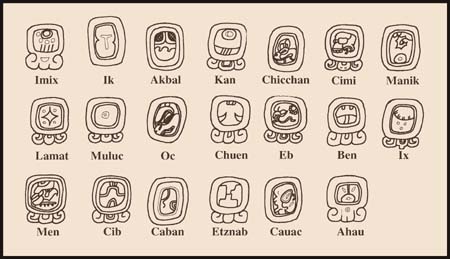
Days in a month of this calendar

New month is just an extension of the old 8. Imish, 9. Ik etc.
Haab solar calendar of 365 days formed by 18 months of 20 days and a 5. They were also awarded the title (and related characters): Pop, Wo, EPA Socialism, Tsek, Shul, Yashkin, Mol, Chen, Yash, Sack, HEC, Mac Kinkin, Muan, cocoons, Kayab, Kumhu, Uayeb. The first month of the year is Pop, start date "0 Pop" and ends with "19 Pop". (With Mayans first digit is 1 and 0.) Last day of the year is "4 Uayeb."

Months in the solar Haab calendar

The Mayans believed that magic number 13 in combination with 20 control human life and from birth to death. For proper development of life and time was necessary and sacred solar calendar unite to leave both the first day and meet at the starting point. This forms the famous "calendar wheel" of the Maya. Imagine it as a set of two gears: one with 260 teeth and the other with 365. The two wheels rotate at the same time - a few first day "1 Imish" and a big "0 King." To meet again must pass exactly 18,980 days or 52 years. This 52-year cycle of Mayan century vposledstive adopted by the Aztecs. 52 yields the number itself magical significance and it accounted for a number of ceremonies and traditions.

All attempts to explain the origin of the ritual in the Mayan calendar remain futile. There is a strong hypothesis that these 260 days are the time necessary to prepare the ground for planting corn to harvest, just the period for land preparation and cultivation of maize is too stretchy. But where science is powerless to intervene quickly other hypotheses. Especially energetic are authors who contend that the Mayans aliens from another planet (at least their priests or at least Kukulkan). For them, this calendar is a calendar on another planet. Whoever does not believe - prove otherwise.

Calendar wheel depicting the occurrence of the end of the 52 year cycle

As for the timing - Maya have several ways to do this. The two most famous ones are called. "Long Count" and "short count". The first causes a real surprise with how comprehensive it is: its boundaries covering periods from one day to millions of years. Here's the system:


Uinal be 20 cinemas (days) = 20 '
Dong is equal to 18 = 360 'uinala
Katun equals 20 tun = 7,200 '
Baktun equals 20 camp = 144000 '
Piktun equals 20 Baktun = 2880000 `
Kalobtun equals 20 piktuna = 57600000 '
Kinchiltun equals 20 kalobtuna = 1152000000 `
Alautun equals 20 kinchiltuna = 23040000000 `
It is easy to consider that one alautun has almost 63 million years. Probably not hard to calculate how alautuna, etc. kinchiltuna take 90 million or 400 million years. These are numbers and dates found in inscriptions Kirigua. More complex is the question of why any. (Of course, not the authors of fantastic hypotheses.)

To date some events in its history, the Maya had to rely on a starting point from which to begin their chronology. If you believe Kirigua for this first "mythical date," Maya have chosen 13.0.0.0 4 Ahau 8 Kumhu or according to our calendar - according to the belief system of correlation - it is August 12 3113g.pr.n.e. (In other 3114g.pr.n.e is August 11.) For serious scholars date is mythical - in view of the present level of our knowledge of Maya culture, and will remain so until I find irrefutable archaeological evidence to the contrary. On the other hand, Erich von Daniken, Alexander Kazantsev, Yuri Morozov, and other writers of fantastic hypotheses, the date in which the planet X, spinning between Mars and Jupiter, has become a huge disaster, the planet was destroyed and its population is saved the earth today we know it as "Maya". On the planet itself that numerous rocks that now form the asteroid belt between Mars and Jupiter.

(Whether you believe this hypothesis or not - it is interesting to know for example, that astronomy has long been identified and adopted as scientifically proven hypothesis that the asteroid belt is not composed of remnants of a destroyed planet, but is rather a concentration of "planetezimalii "ie rocks that would form another planet, but it prevented the powerful gravitational field of Jupiter.)

At the end of 9c. AD began the decline of the Maya culture in the central areas and the invasion of foreign conquerors. During this period, losing much of the knowledge of the Mayan calendar-related. So stop priests take time for the system of "long count" and its served with a simple system called "short count". One cycle comprises only 13 camp - a little more than 256 years. Katunat be displayed with the day on which it ends - the day Ahau. This system puts an end to the amazing precision of calendars, since mistakes in ten years.

Haab and Tzolkin addition to other systems without time recording of scientists creating enough headaches Mayans had more ways to do so. Eric Thompson, studying hieroglyphics of some monuments, concluded that there are some "esoteric" calendar of 819 days. It was based on religious beliefs in different gods - earthly seven, nine and 13 underground heaven. 7h9h13 combination gives this cycle of 819 days.

There's also a shortened version of the long count, but it is not seen as a separate calendar. If it only count dates called "finals" and are final dates specified periods, primarily camps. If the recording date mention the serial number of the camp - it is the end date of a period of 949 Baktun, or a mere 375,000 years. If you do not mention the serial number of the camp - then it is over 949 camp that is "only" 19,000 years.

Understandably, some authors say that the Mayans were right fixated on time. As if they lived with only one obsession for the future, the past and seemed not make light of the present.


вторник, 20 ноември 2012 г.

Mayan people


What accounted for the people living in the Mesoamerika? This also knows many things, but mainly due to reach us works of Diego de Landa "Exhibition events in Yucatan" and "True story of the conquest of New Spain" of Kortesoviya soldier Bernal Diaz del Castillo. As you can guess, some things two "missionaries" are quite distorted historical truth.
 Maya man was small of stature, an average of 1.65 meters, with brown skin, closer to the color of copper. Wide faces with protruding cheekbones, slanting eyes and long, straight black hair. Barber profession was not developed due to very low hairiness, and these beards are rare because their mothers at birth of the child burned his face with hot compresses to not grow hair. This applies equally to the ruling caste, and the common people. Only complete opposite situation was fully clothed.
The old rule that clothes can judge a man goes for Maya. Class division in this civilization proyavayava in the way of clothing. Lords of the nobility covered their shameful parts "waist and between the legs" with a loincloth (or fatty mashtlatl) - wide and nedalag stretch of woven cloth "hanging front and back." Wore more "shikole" - something like striped jacket, adorned with feathers, large square robes and sandals of various types. High-ranking dignitaries and used "tiger" skins (de facto jaguar), decorations for hands and feet, and many jewels. Clothes were really one of the things which you could probably recognize a representative of the ruling caste.
In contrast, ordinary people are satisfied with the more modest "clothes" - a simple loincloth. In chronicle "Exposure of Valladolid" states that "many Indians go naked." De Landa acknowledges that "buildings are constructed of naked Indians, who wore a decently long strips called ex". In paintings such, and clothing of slaves, captives and sacrificed. Statuettes from Hainan Island show that the most important for the brilliance of clothing were hairstyles, hats and head decorations. It depicts all kinds of turbans, tiaras, feathers, braids, wide-brimmed hats. Even if the figure is nearly bare, the head can be judged klasovat her identity.

In another situation clothes for women. Landa speaks with great sympathy for the Indian of Campeche and Bakalar, which showed more integrity in his clothing: skirts unless they wore from the waist down, covers the chest. Women from other regions using only long wide blouses stigashi to the flanks, but they went totally naked because you never parted with their long cotton gowns. They pulled at night. The most popular women's clothing was colorful tunic and skirt to the ground. Were wrapped in embroidered sandals. As for the female figure itself - de Landa it is better placed than Spanish, Castilian without broad hanshove. "Those are nice, quite vain and really do not look bad."
Beauty itself is relative. Especially when talking about Mayans. For example - what beautiful can have swelling in the artificial nose, large holes drilled in the ears, especially in the deformation of the skull, but Maya otherwise. Archaeological monuments and Spanish chroniclers assure us that it is not about race or hereditary traits, and to induce change. Many murals represent typical human head maya - highly flattened forehead and aquiline nose. This happened a few days after the baby placed his head sandwiched between two boards - on the neck and forehead. Most often, however, the baby died a few days later. Another way of warping is very tight bandage around the top of the head - resulting in a cylindrical shape of the head. Of course - if the child live. Not only knows that such things are done only rulers or common people.
Things are different, however, with inlays of precious teeth. Damage to the teeth with cosmetic purposes was widespread among them - filing as sharp mountain ridges they are believed to be particularly beautiful. Time addressing some of the older women, according to Landa they did it "with some stones and water." It may seem cruel, but surely both of them will seem harsh diets that lead to anorexia, modern women who applied widely. A milled tooth applied both by women and by men. More complex were incrustation - usually cuts a tooth surface, filling with obsidian and jade. This was obviously up to only rulers.
And besides, like tying a small ball of string to short hair, so hang in front of their forehead, Mayan achieved yet another symbol of beauty - squint. Thus pupils gradually "distorted" inward and gathered on both sides of the nose. Just like the cartoon. Except that it makes them more beautiful rather than ridiculous.
 Overall Mayans were quite pure-bred. I dare say even more than us today. (And what about the conquistadors!) They bathed several times a day with cold water or steam bath. In this steam bath was more about health than cleanliness. Bathe men and women together without doing some parsing. A man who was returning from work and his wife was not prepared to meet him with bathing water had the right to beat or punish otherwise. Spaniards saw forced to recognize that right and posterior to the colonial legislation. Overall, they were monogamous, had only one wife. (And she - only one man.) However, this was true only for "inferior, vulgar and coarse people," while the ruling classes often found bigamy, people had two women.
Marriage is an important event in the life of every man and Maya watched him with the necessary seriousness, though their practice in this area was much more liberal than in many advanced countries. For normal age of 12 years was considered. The parents of the boy were those who sought a bride, not back, to find a suitable girl should negotiate. Scream is a priest for the ceremony, which explained in detail what marriage means, what are the obligations of both sanctified and after the house in which you live, go. The marriage was concluded. Moreover, the groom had a very unpleasant duty - to work his father in law four or five years, if not satisfied that - threw him out of the house and the marriage is declared void.
Many Spaniards resent the ease with which the Maya are getting divorced. In this search for a new bride begin anew, without the least delay. Widowed they married again without prolem, but after one year of the death of his partner. Curiously, women had no rights of inheritance. If the head of a family dies, and no male child, the property goes to another man - a brother or cousin. But he had to take care of children and the wife of the deceased.
Landa speaks very judgmental tone Mayan vices, especially for their drunkenness. Having drunk, he says, doing very bad things: murder, burned the houses, refer to their parents as enemies, thrust into a strange bed and "poor women think that men sleep with her." (??) But besides drinking and making merry, Maya loves to dance. The music is performed by wooden "trumpets" shells, "flutes" from deer bones or reeds and various drums. Sometimes a dance flown by eight hundred, none of the dancers do not confuse rhythm. The bad thing was that the dancing lasted all day without interruption. Moreover, women often participated in a cultural dance with men.
 Funerals and funeral rituals, reveal chronicles were directly related to social categories. Dead of lower class simply buried corpse buried in the ground, inside the house or close to it having previously mouthful of the deceased with cornmeal with koyem drink and a couple of pebbles used instead of money. (Cash for common people, traders used cocoa beans.) Also threw in grave idols and some of the items that the deceased loved as a living.
Lords and noble persons are burned and the ashes are kept in clay urns. Furthermore, individually and collectively have practiced burial. This is done at the funeral of another real person or important person: Near the tomb is placed urns with ashes and residues from skeletons of sacrificed individuals to accompany him in his travels underground. Social differences are identified and the number and quality of the objects buried with the corpse.
Also important was the baptism of infants. In Maya infant received the name of his day and the sequence number in months. This christening was more or less automatically and legalizing a simple ceremony at the temple. The real baptism, however, is much later, when the child even fathomed puberty when they had to be "born again." Therefore intricate ceremony is called "koputsihil" - born again or a new life, and the reception itself - "emku" - descent of the gods. Preparations for it began more than three years old. Then the mothers of boys tied strips of white cotton tuft of hair, and the girls received belt, from which hung to the private parts shell. Lowering them to baptism under any cause was considered a sin. Baptism itself - becomes a solemn ceremony, when children reach the age of twelve. The children who will be baptized, gathered in a courtyard - a man who can take charge of naming all the children of the "neighborhood", including his. The girls were accompanied by old women and boys - from older men. Then the priest, after giving them a few corn and sprinkle them with water, cut the cotton strips in the hair of the boys, and his assistant flow of several tobacco leaves. The girls filed flowers, mothers cut their own belt with a "guard" their virginity shell. Then we all retired.
Now boys can smoke. Smoking with pipes made of clay, but unlike the pipes outside the territory of the Maya, their were decorated with bird heads and images of animals. Some were made in the shape of animals. There were pipes with "chimneys", oblong or round. They put finely cut tobacco and other tobacco was rolled and lighted at one end.
 As for justice for Maya - was the so-called "sweet potato" which was something of a prosecutor. Besides its been something like judges who heard the parties and issued sentences true. There are people who play the role of lawyers. The crimes were generally of two types - "public" and "personality." In the first are paid more money, and if guilty he could himself pay it permitted the relatives or friends to help him. However, others were extremely harsh penalties. For example, for murder - intentionally or accidentally - is always punishable by death. Minors killer became a slave. Even the smallest theft is punished with slavery for a period of time, depending on the value of the stolen property. If the thief is not able to recover the entire amount would remain slaves forever.
Adultery punishment Landa describes as follows: "Upon completion of the investigation and conviction of a man for adultery main parties gathered in the house of the chief, which led adulterer, tied to a tree and gave it to the husband of the woman. Forgive him if he - goes to free, if not - kill it by throwing down on a large stone on his head. " Adulterous woman was punished with death, but often only denounced it. Death is punished more: raping girl or married woman treason against his master, intentional burning of a fire. Sodomy shall be punished as a perpetrator be burned alive.
Generally most curious about the justice of the Maya is that it applies equally to all, whether people are the ruling caste or vulgar. Even in our modern society is still only a distant dream.
 It is interesting to mention the "igratata Ball" - "POK POK it." She had a separate god. The official version is that the name comes from the characteristic sound that is heard when the ball hits the ground. Played with two teams of two or three players. The aim was to put the ball (which is less than football, but much heavier) in a small stone ring hanging slightly above the ground. Players were allowed to hit the ball with knees, elbows and hips, but never with the hands or feet. Was prohibited and falls to the ground. Team wins who first ran the ball through the ring - a single course.
Games were many. Only in Chichen Itza, to ten. It is interesting that some have slanted walls, others with sheer. The biggest playground "PAC-it-PIC" is exactly Chichen Itza, right next to the Temple of the Jaguar (the main sanctuary of the god of rain - Only-Mool). It's dimensions are 100x40 meters. Moreover, it was a small and temples that served as offerings after the game. Lodges are divided in such a noble and vulgar personas. Tickets are not paid, everyone was free to go to the game if he wants. The most interesting course where exactly is that if you stand facing a wall surrounding the lodge and say something, though silent, it will be heard without a problem right across the field, the opposite box.
There Reserved carvings, which shows how a priest sacrificing player after the match has finished. Then the balls are ritually burned. Here disputes arise: winners and losers sacrifice? Most favor the first hypothesis, but it seems more likely that priests to offer the winners. However, what greater honor could get a person from being sent directly to the gods where you expect eternal life in bliss and infinite happiness ...